ANDREA CÁRDENAS

C E R A M I C A R T I S T


I believe art is something that must be defended in these times. When violence, fear, and simplification dominate public discourse, art becomes an act of protection—of humanity, of complexity, of the sacred. Making art is my way of resisting silence and preserving what cannot be measured or controlled.

I work with ceramics because I survived.

Because clay allowed me to stay when everything pushed me toward disappearance.

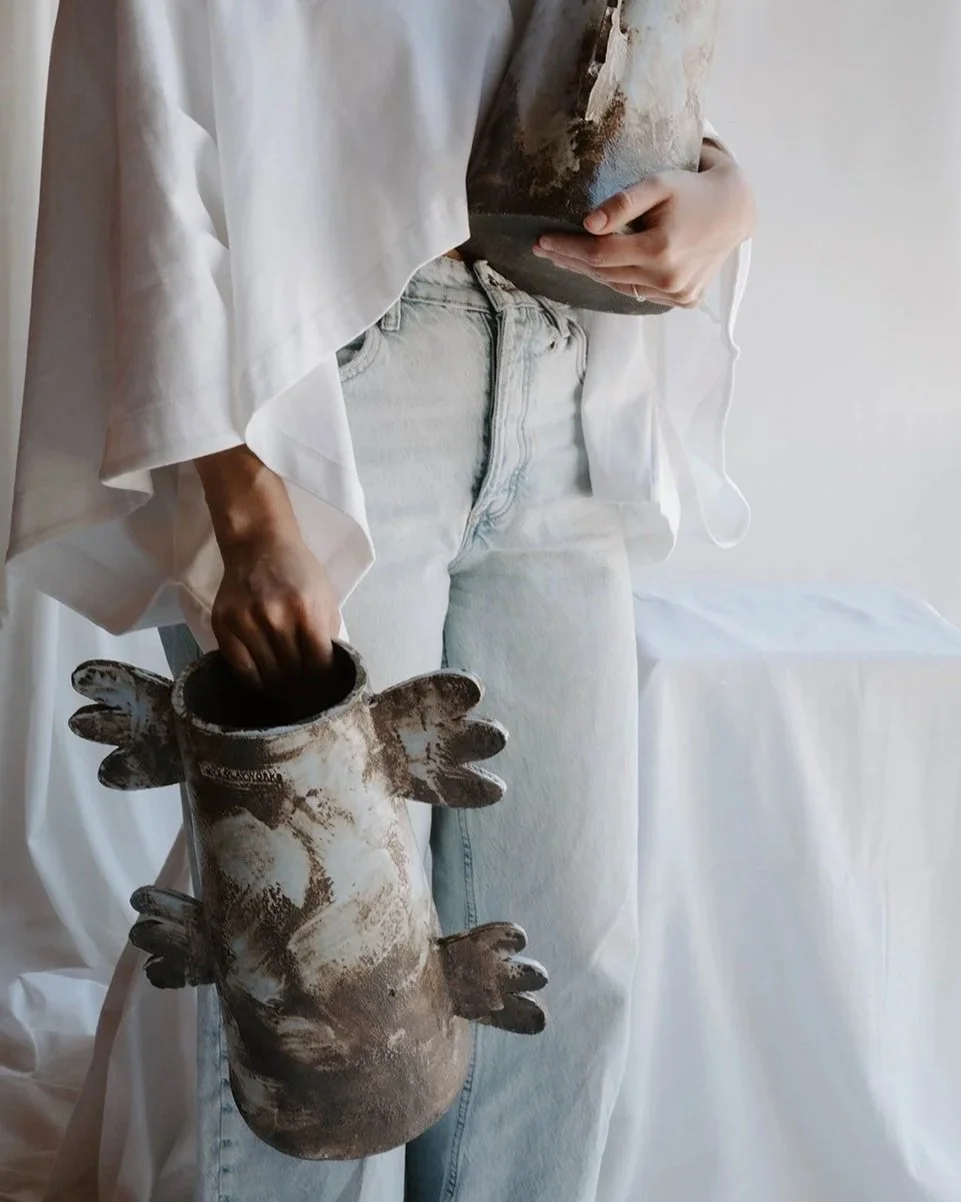
I was born in Yucatán, a land where the sacred and the dark coexist without asking permission. My creatures emerge from this lineage: bodies that cannot be understood with a single glance, faces that are not masks but portals. Each piece is a complete being, with its own character, memory, and contradictions. Nothing is only a face.

My work explores the duality that lives within every person: light and shadow, faith and doubt, beauty and fear. My relationship with God is neither simple nor comforting; it is deep, sometimes uncomfortable, and always present. Through clay, I confront what cannot be spoken aloud.

Before becoming an artist, I was an interior designer. I learned how to construct spaces. Now I construct presences. The transition from design to art was not an escape, but a reclamation—I always knew I belonged here.

I am a Mexican woman working in the United States, shaped by displacement and reinvention. I am an autistic woman, diagnosed in adulthood, who learned the name of her difference late, but never the depth of her strength. Reaching art was not a clean or easy path; it was an act of resistance.

My childhood was marked by abuse and violence. I do not work from victimhood, but from survival. Art is not decorative catharsis; it is a way of remaining, of transforming wounds into matter, weight, and presence.

I work with darkness not to glorify it, but to face it directly. I believe in a deeper vision: characters that hold history, spirit, and contradiction. Creatures that return to us the question of who we are when we stop pretending to be whole.

Working with ceramics is a slow act in a world that demands speed. It is touching the earth, accepting failure, allowing fire to decide. In that process, I find truth.

For me, art is not a choice.

It is survival.

It is root.

It is imperfect faith.

It is a body that remains.